

Commercial and industrial demand response has been around for decades. Data centers, though, have only recently started to take the idea seriously, driven by the load growth constraints now facing utilities and grid operators everywhere.
Google has been ahead of that curve. The company recently announced 1 GW of contracted demand response capacity across utilities in the US. The question is: how does Google actually do it?
We’re excited to announce a Spotlight Main Stage Session at DERVOS that answers it.
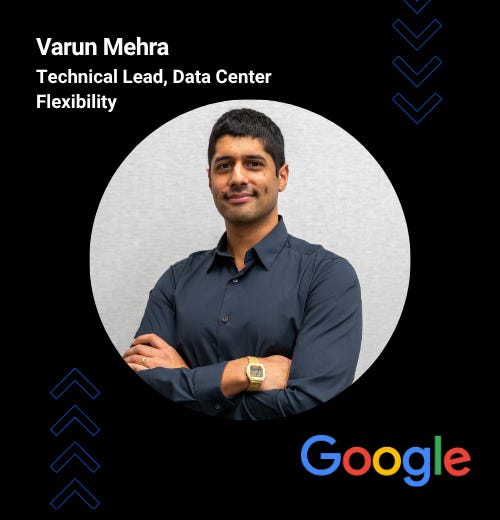
Varun will take the audience inside Google’s data center fleet to show what has happened, and what is happening now, to make demand response work at hyperscale.
What you’ll learn
Hyperscale flexibility, demystified. What does it mean for a data center to be flexible? Varun will cut through the assumptions and explain how it works in practice.
The 1 GW milestone. A look at what it took to reach 1 GW of contracted demand response capacity across US utilities, and what that signals for the industry.
The technical mechanics. Google started with CPU-based demand response, and the approach has since evolved to ML infrastructure. Varun will cover how that progression happened and what it takes to deliver capacity at scale and across time horizons.
A bridge to the DER and VPP ecosystem. Hyperscalers and the distributed energy resource community have more in common than it might seem. This session explores where the two worlds connect and what each can learn from the other.
Why this matters for our community
Our community has spent years building the tools, markets, and trust needed to make distributed flexibility a reliable grid resource. As large loads reshape the planning conversation, the line between “data center” and “flexible resource” is blurring. Hear more at DERVOS.