

I just published this on X and to my personal substack. Duncan, Colleen, and I thought you all might like it too. (For some reason, it’s not letting me cross-post, so here it is as its own article).
Our work @TheDavidEnergy leveraging bi-directional, plug-in batteries to lower costs for small businesses is now public, and it coincides with some broader macro shifts in the power sector that I’ve been meditating on.
The power of plug-in is remarkable and comes at a time when our regulatory construct is falling behind. If we wait for permission from that construct, we’ll never move as fast as we need to. Plug-in is our way out, at least for consumers and businesses.
The shift from permitted solar + storage systems to plug-in is as big as the shift from on-prem to the cloud, or mainframe to PCs, or however you want to think about it. Imagine if every time you bought an iPhone or laptop, you needed a permit and an inspection--the internet never would have taken off with that much friction. Plug-in is the frictionless path to scale the DERs movement has been waiting for and will soon become the dominant form of DERs deployment.
After seeing plug-in in action over the last few months, it’s clear that we are at the dawn of a new era in DERs, led by a small cadre of companies like us, @ImpulseLabs @sdamico @EcoFlowTech @channingcopper @pila @ColeHAshman @Bright_Saver @KevinChou @CoraStryker @EveryElectricCo @ndrewwang and more applying plug-in technologies.
What we’re doing
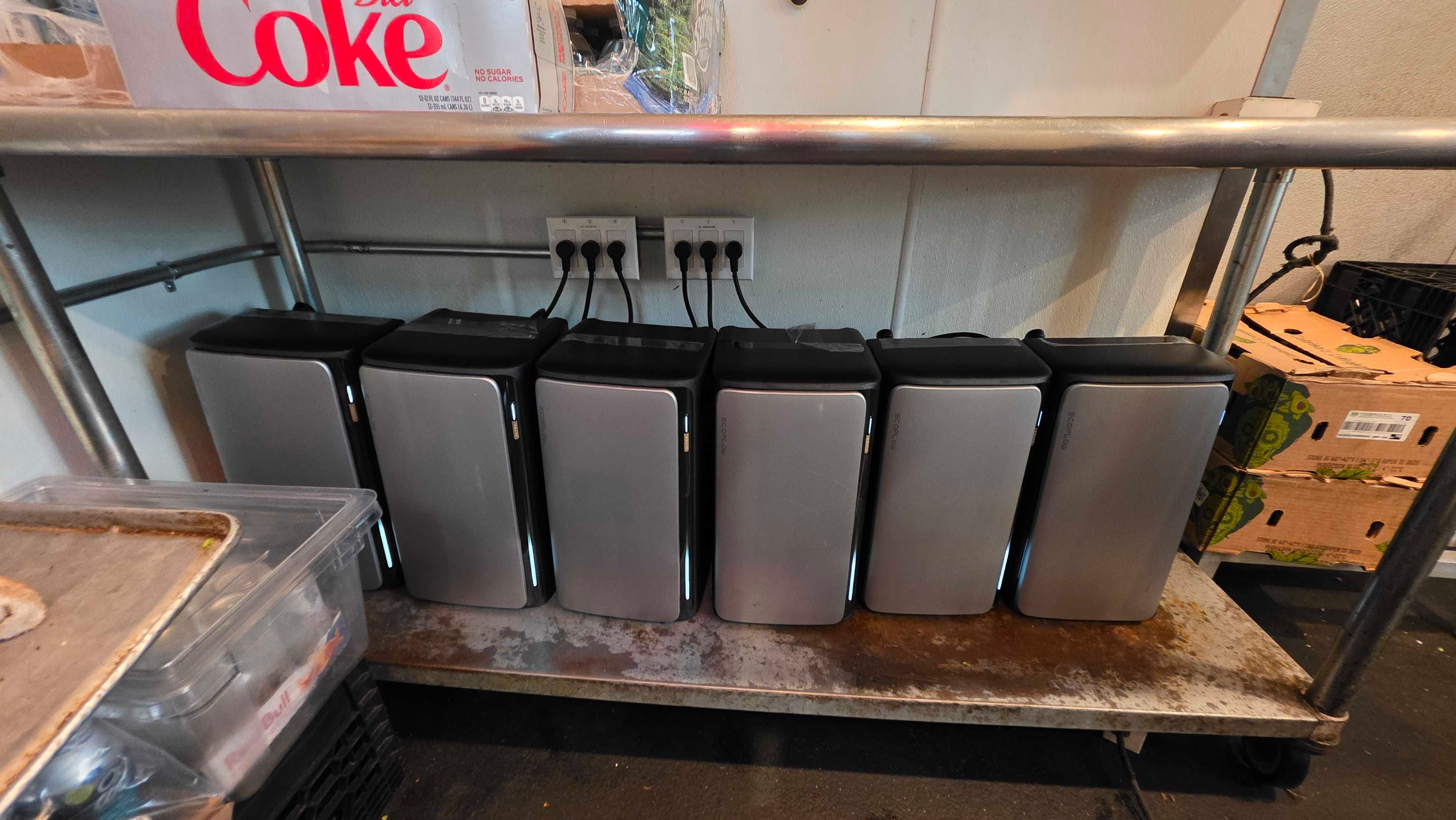
We guarantee customers we will “beat the utility” if they let us take over their energy supply and install plug-in batteries on site. Since launching just a few months ago we’ve signed up hundreds of restaurants, coffee shops, gyms, laundromats, and more representing 10’s of thousands of MWhs of power demand (the equivalent of thousands of homes), and it’s only accelerating. Plug-in has unlocked the entire segment of small business that’s historically been left behind by the DERs industry and it’s incredibly scalable.
The rapid success of this launch is due to three important and novel properties that broadly apply for plug-in and is new for DERs:
It’s a no brainer for customers. There’s no capital requirement upfront or long-term commitment and they see savings day one. We’re not selling a premium sustainability or resilience product. We’re just lowering costs--across both delivery through demand charge management and supply through aggregation--in one simple value prop and vertically-integrated solution. Customers are feeling the pain of rising costs, and we alleviate that pain.
Plug-in batteries do not require permits or complex installs, which allow us to scale incredibly fast and cheaply in a market where no one thinks that is possible, NYC. We can sign a customer on a Monday and deploy by that Friday. Our soft costs are <10% of total system costs, compared to an average of >50% for traditional single-family residential systems. There’s no need for costly alterations to the existing panel or service, we just deploy as much capacity as we can with the existing interconnection. At the theoretical limit, we are bound only by hardware costs, which continue to plummet, not the soft costs that have plagued residential solar and storage.
We serve tenants, not land owners because it’s incredibly easy to pick up and move batteries. This will change underwriting dynamics of deploying what are still infrastructure grade assets and it’s why we don’t force them into long-term commitments. This property in particular democratizes access and will open up entirely new segments to DERs.
These same properties apply to other new verticals, like multi-family renters, which won’t be far behind.
Why it matters
Load growth is back and our existing institutions don’t seem to be adapting quickly enough. Plenty of ink has been spilled on the topic, but it’s worth reiterating that we’re doing this to ourselves. Above all, our own bureaucracies and red-tape are what are slowing us down most--not technology, will, capital availability, or customer demand.
Solar and storage has been 95% of new interconnection the last two years, but the future of that continuing feels uncertain. We’re seeing a number of serious headwinds for the industry: The solar ITC is going away. The federal administration wants to make it harder for the industry at every turn, and local jurisdictions (even in blue states) can’t get out of their own way. Our largest power market, PJM, is a mess and the queue they just opened up is dominated by gas. In the best case, deployment is way slower than it can and must be to deal with rising demand.
Plug-in represents a new pathway to deployment that doesn’t require any centralized permission or coordination. In fact, the worse our centralized system gets--and the higher resulting costs to consumers--the stronger the bull case for them. Customers will just take matters into their own hands, as they did in Germany with plug-in or at the extreme, Pakistan with grid defection.
Where we’re headed
Plug-in will soon dwarf traditional residential and commercial interconnected systems. Contrary to the public perception, plug-in does not mean small and it’s not just something you do if you can’t do it the traditional way. At David Energy, we see a path to be deploying 100kwh+ systems in buildings that are incredibly cheap and superior to comemrcial rooftop or ground-mounted systems. While the commercially available products are small today, this will soon change. We will see 10s of GWs deployed across the US in just the next few years and beyond that, hundreds.
Our existing systems will have no choice but to adapt to them because they’re going to scale so fast. Soon, they’re going to be everywhere. Over the last decade, I’ve watched too many good companies and good solutions struggle to get adoption while they worked hard for policy change that never came. Plug-in is not anti-institutions or anti-regulation, but it’s not going to wait for them.
These systems are safe (UL certified), reliable, and just make sense to do from an engineering and economic standpoint. There’s really no way to stop them, and no reason to. This means they’re coming, whether we’re ready for it or not.
This is some out of the box thinking. Really appreciate the DER Task Force shining a light on this. It's the kind of news that doesn't get enough attention! While everyone debates the big-picture energy transition, businesses are quietly plugging in batteries and just... getting it done. Plug-in battery solutions represent exactly the kind of practical, scalable innovation that bridges the gap between today's grid limitations and tomorrow's clean energy goals. Storage is the missing piece that makes solar, wind, and demand flexibility actually work together, and the faster batteries become commonplace for businesses, the closer we get to a grid that actually works for everyone. Here's hoping policy and infrastructure catch up to the momentum that innovators are already building.
Why are plug in batteries only targeted to business? Why not consumers ?