


Executive Summary
For the fourth year running, the DER Task Force held its annual gathering in New York City, assembling the brightest minds and most boisterous voices from across the distributed energy ecosystem to contemplate, prognosticate, and hot-take their way through the industry’s most exciting opportunities and most excruciating challenges. With over 750 entrepreneurs, policy wonks, equipment manufacturers, investors, utility staff, regulators, and more trekking out to Governors Island, DERVOS 2025 was bigger than ever – just like the stakes of the moment.
Across DERVOS’s full day of programming and the Leadership Summit held at Brooklyn’s Newlab the previous day, discussions coalesced around five key themes:
Theme 1: Our time is now. An electricity affordability crisis is engulfing a growing number of states across the country, dominating voter concerns in elections and undermining America’s competitiveness in key “electrotech” industries like battery storage and robotics. Perhaps even more viscerally, increasingly-frequent extreme weather events are driving unprecedented grid reliability challenges for communities and businesses nationwide, with costs that can similarly be measured in billions of dollars – and, in some cases, lost lives.
DERs offer the most immediate path to providing ratepayer relief as well as resilience against grid outages, and this year’s DERVOS highlighted several examples of gigawatt-scale VPPs making this promise real in selected markets in the US – and, even moreso, in the ultra-competitive UK power market. So, the time is now to scale up and meet these urgent needs; in the words of one prominent industry voice at the Leadership Summit, “we’re in a moment where our services have never been more needed, and more important… people need us to be successful.”
Theme 2: Our speed opens new frontiers. Alongside cost and resilience, a third major driver for our industry came into focus at this year’s DERVOS: the need for speed(-to-power), and the ability of DERs to offer solutions to grid interconnection challenges for end-users at scales ranging from small to XXL.
On the smaller side, DERVOS looked for the first time at the emerging category of “permissionless” DERs – appliance-like solar and battery storage systems that can plug directly into devices and power outlets without complicated and time-consuming utility permitting and interconnection processes. While these systems are typically limited in size versus their “permissioned” counterparts, the meteoric growth of “balcony solar” in Germany since Russia’s invasion of Ukraine demonstrates that speed can be a major unlock for the mass-market adoption of DERs by homes as well as businesses.
“Big DERs energy” may similarly hold the key for solving today’s biggest and most urgent energy challenge: powering the gigawatt-scale data centers required to power the suddenly-enormous AI economy. Having DERs, especially battery storage, or “being” DERs – having a certain amount of demand flexibility — could facilitate faster grid access for data centers currently stuck in yearslong interconnection queues. Ambitious DERvelopers are also aiming to bring data centers online even sooner with completely off-grid installations, representing unprecedented “macro”-scale deployments for microgrids. Either way, DERVOS panelists from both big tech and big DERs agreed that these types of solutions would very likely be necessary for achieving the “bull case” for AI in the US.
Theme 3: Our economics are our destiny. Given the aforementioned urgency of providing relief from skyrocketing utility rates, along with the pullback of policy incentives at both the federal level and in some states (notably California), multiple DERVOS segments as well as Leadership Summit discussions focused on the need to unlock the true multi-faceted value that DERs and VPPs provide.
At 2024’s event, DERVOS shone a spotlight on Texas as a fertile ground for DERployment due to its uniquely competitive retail market in the U.S. context; this year, we looked across the Atlantic for inspiration, with UK-based companies including Octopus Energy, Hypervolt, and Axle Energy hailing how “the most advanced power market in the world” is enabling DERs to scale up by monetizing the full range of value they can provide across both the transmission and distribution systems.
The latter was a particular focus of a panel on VPP deployment, where aggregators lamented the lack of opportunities to realize the locational value of DERs and compete against the distribution grid upgrades that are a primary driver of rate increases. In recognition of this value, a panelist from utility giant Xcel energy discussed their plans to deploy DERs at key locations on their system through a distributed capacity procurement (DCP) model – and, encouragingly, spoke of the need for more dialogue between utilities and DER providers on the path towards trusting VPPs as resources that are equal (or superior) in value to traditional power plants.
Theme 4: Our politics are local. While whipsawing federal policy direction provided an unavoidable backdrop to certain discussions, particularly a geopolitically-themed panel on “Energy Dominance and the Electrostate,” most policy talk at DERVOS centered around state policies. This was nothing new – DERTF has always had a non-partisan flavor and a state-level focus appropriate to the localized nature of distributed energy – but this year’s event saw several areas for action come up repeatedly.
Require Utilities to Utilize: Regulators should require utilities to maximize the utilization of existing grid infrastructure that has already been paid for – and, in the process, enable DERs and VPPs to compete as lower-cost alternatives to distribution grid upgrades.
Flexible Interconnection: Large loads (i.e. data centers) should be able to connect to the grid sooner by agreeing to curtail their electricity use during periods of peak demand – potentially by drawing on on-site batteries, multi-DER microgrids, or even VPPs.
Permissionless Backfeeding: To unlock the potential of permissionless DERs, states should follow Germany’s example and allow these systems to export a limited amount of excess energy to the grid – as U.S. nonprofit Brightsaver is advocating for across over a dozen states.
Valuing Resilience: To realize hard-to-quantify resilience value, utilities could be allowed to rate base microgrids sited at essential facilities, or subsidize batteries in high-risk areas in exchange for the ability to use them to support the grid during emergencies.
Returning to the overarching urgency theme, the Leadership Summit also saw speakers emphasize the importance of getting involved early in educating and supporting candidates in key state legislative and gubernatorial races coming up in 2026. The recently-formed advocacy group Deploy Action was called out in particular for its work advancing DER-friendly policies in California this past year, which it is working to replicate in other states.
Theme 5: Our community is dope.
A final theme of DERVOS 2025 was the way the event helped to amplify and crystallize the DERTF community itself. DERTF has grown organically from informal meetups in NYC into a nationwide organization capable of pulling off this utterly unique event – with its Governors Island location, a list of high-profile attendees and panelists to rival any traditional “industry group,” plus a high-powered Leadership Summit and the first-of-its-kind solar and storage-powered New Energy music festival (!) – while maintaining a distinctively accessible, no-bullshit vibe that “makes this feel like family and fun and friends.”
So, given the stakes of the moment, and the palpable momentum and ambition of the community, how can we “figure out how we can grow together?” Deeping our alignment around key state-level policy priorities, and putting our energy (and, yes, donations) behind candidates that support them, could be hugely impactful. And beyond aligning on a political agenda, many respondents to our first-ever Community Survey highlighted the need to align around interoperability standards as the industry scales, as well as the need for more productive and collaborative engagements with utilities. Both of these themes were touched on in multiple panels, demos, and exhibits, and they could well be a growing focus of future DERVOSes.
Finally, DERVOS 2025 shone as a place for coming together around a shared narrative and sense of community across the uniquely diverse collection of technologies and stakeholders that DERTF represents. Whether aligning around new industry descriptors like “electrotech,” making new connections over burritos on the sunny lawn of the Parade Ground, or tuning into the experimental sounds of Eartheater – who closed out the New Energy festival on Saturday with an exhortation to keep doing “new and innovative and hard” things – DERVOS 2025 left us feeling more motivated than ever to build towards our collective success.
It’s never felt more urgent – and we couldn’t be more excited to reconvene next year.
If you prefer reading a pdf document, download this paper here:

Otherwise, continue reading below.
DERVOS 2025
A Spirited Scaling-Up
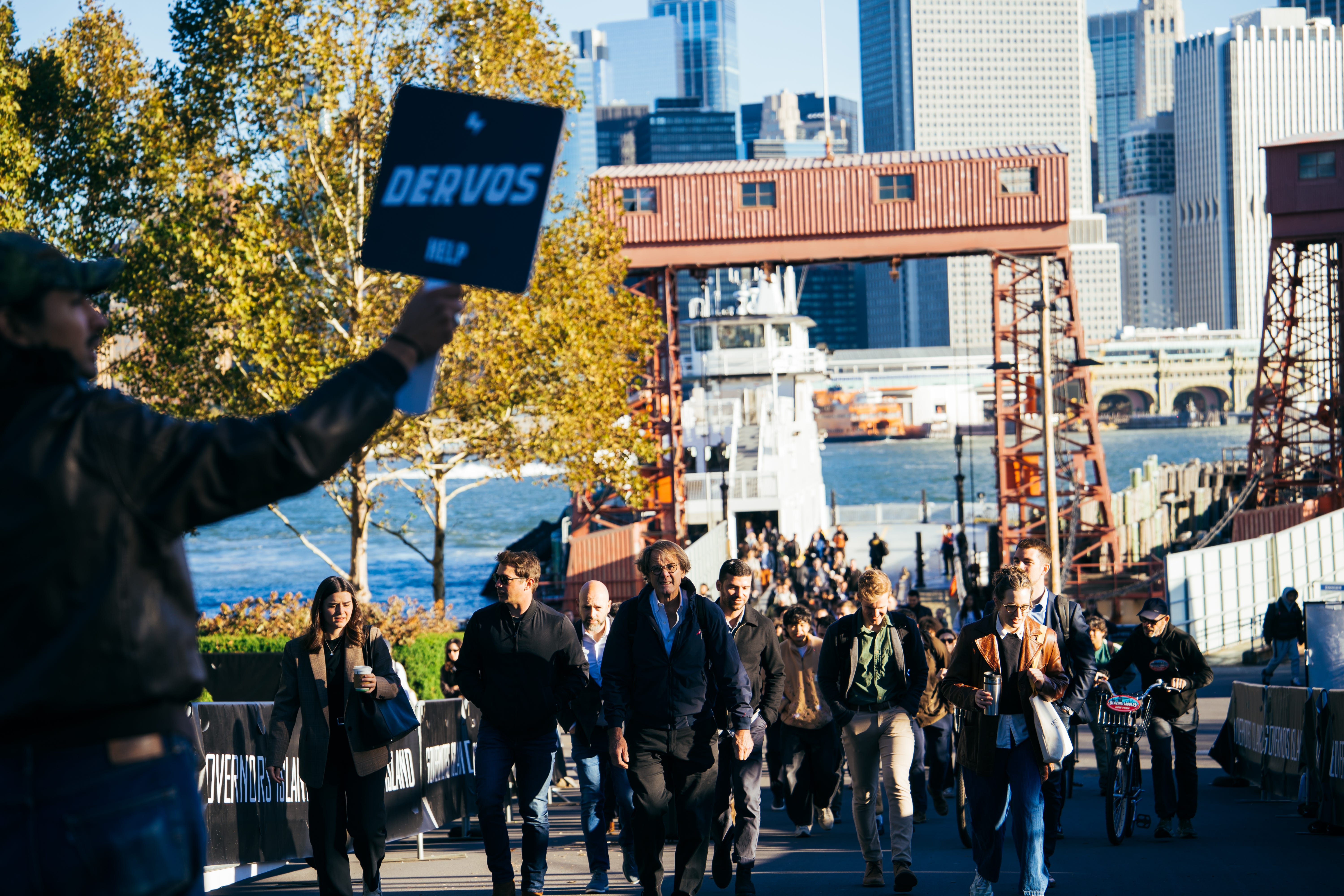
Riding New York City’s first hybrid-electric ferry to Governors Island on a bracingly-windy but sunny mid-October morning, the energy was palpably, generously distributed. We were on our way to DERVOS 2025, the fourth annual, perennially-unconventional conference of the DER1 Task Force, and the size and diversity of the crowd – 750 attendees encompassing not only the usual entrepreneurs and policy wonks but also regulators, tech giants, utility staffers, philanthropists, and investors – spoke to the unprecedented scale of this year’s edition as directly as the new venue’s sprawling, music festival-ready setup and spectacular views of the Financial District skyline.
In some ways, the event’s quadrupling in attendance since its first edition (“DERTfest,” yes pronounced “Dirtfest”) felt natural. While renaming the event after Davos in 2023 initially registered as an ironic riff on the group’s anti-establishment iconoclasm, it has increasingly felt like a sincerely earned statement of belief in the world-shaping potential of the industry. And as the crowd smiled, shivered, and optimistically chattered through chilly pre-event conversations across the Parade Ground lawn, you’d be hard pressed to find any signs of the anxious gloom that pervaded coverage of the energy industry during the first 10 months of the year.
Of course it was, in unavoidable fact, the first DERVOS of the (second) Trump era. “This administration is trying to pour cold water on our space,” DERTF co-founder (and David Energy founder) James McGinniss acknowledged in his introductory remarks, “and there are people in this room who have felt that pain directly.” But, like the DERTF faithful’s resilient cheer in the face of the cold winds sweeping across New York Harbor, the headwinds from Washington, DC were largely ignored for the next 8 hours of heady theorizing, determined strategizing, and irreverent evangelizing.
Indeed, if anything, the ostensibly daunting political backdrop made DERTF’s perpetually insurgent attitude and blithe disregard for partisan national politics feel more vital and relevant than ever. After a day that warmed into an idyllic fall afternoon and a balmily buzzing evening, Impulse Labs founder Sam D’Amico enjoyed a happy hour cocktail on the lawn and spoke with a confidence that seemed to echo from every speaker, panelist, and attendee during the previous 8 hours: “We’re the losers on the policy side, but the winners on the technology side – and I would argue that we now have tech that can stand up to an adversarial environment.”
Amping Up the Ambition
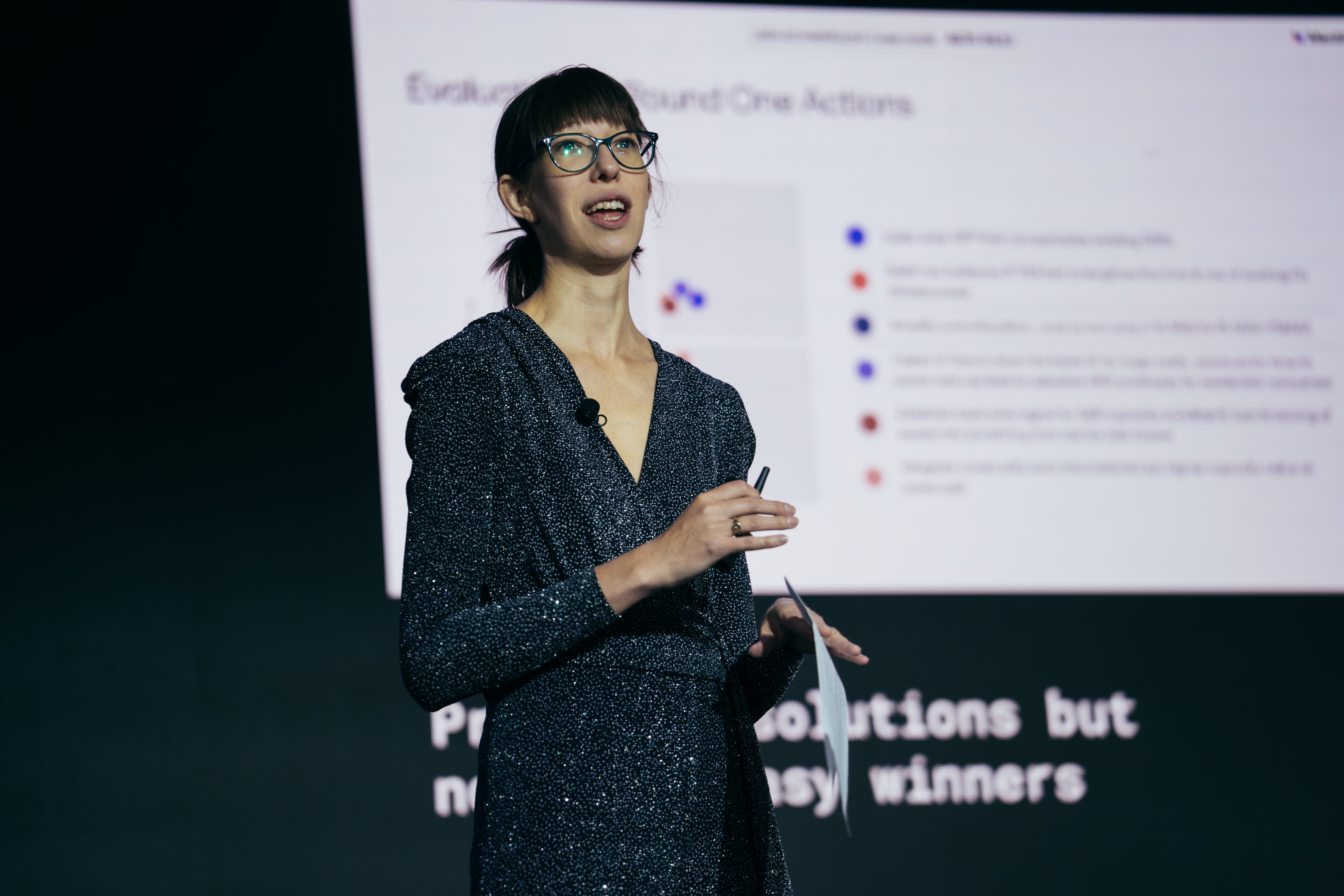
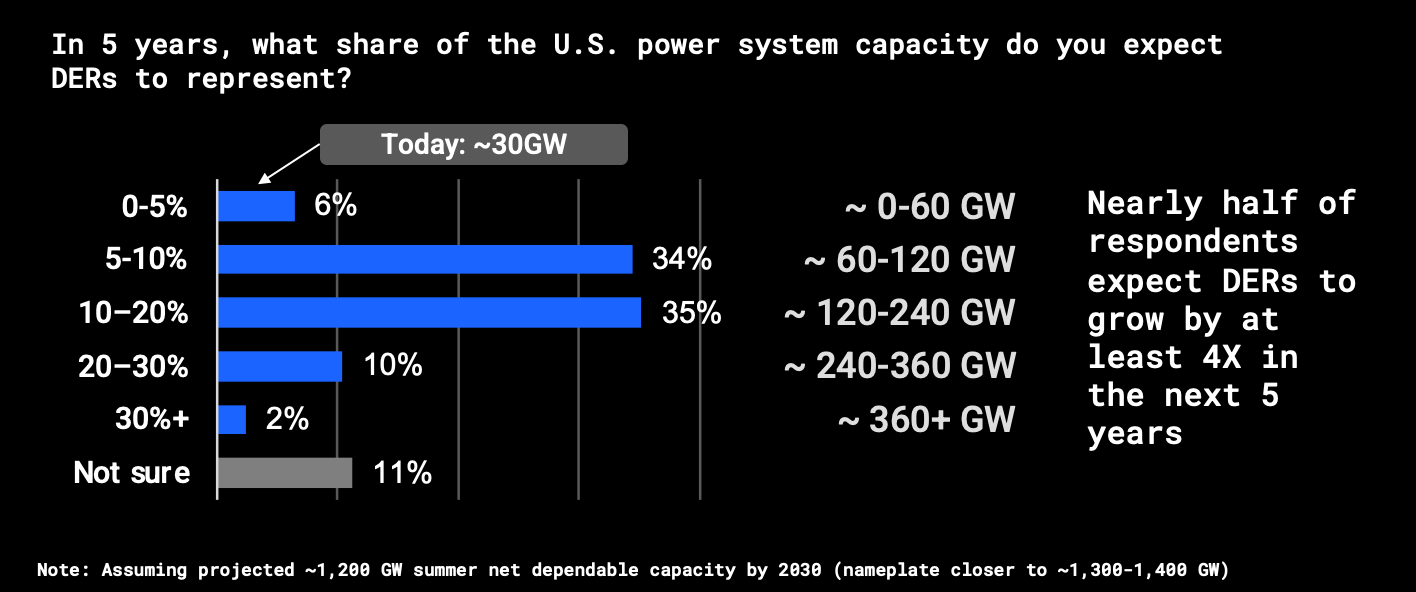
That confident spirit was channeled at the start of the day by DERTF-cofounder (and Scale Microgrids Senior Director of Strategy) Colleen Metelitsa, shimmering in her usual-for-DERVOS sequined jumpsuit, as she shared the results of the group’s first annual Community Survey. In presenting the survey’s results the previous day at the also-first DERVOS Leadership Summit – a smaller convening at Newlab in the Brooklyn Navy Yard, which had hosted previous DERVOSes – one slide in particular was called out as “the LFG slide”: nearly 50% of respondents expect DERs to at least 4x their contribution to the US power system in just five years, from 30 GW today to 120 GW or more.
While that could sound over-confident to some, this industry-wide ambition ended up sounding remarkably grounded after a DERVOS kickoff keynote address from Type 1’s Jesse Peltan. Solemnly solar-pilling the audience in hypnotic tones reminiscent of Morpheus from The Matrix, the legendary Xitter-poster recited a litany of increasingly mind-blowing facts about the staggering scale of solar (and storage’s) potential – more than all known uranium reserves, more than all the uranium in the ocean…
And perhaps most importantly, the fact that China is on pace to install enough solar this year to generate more electricity than the entire existing US nuclear fleet. “Nothing else compares to solar in abundance,” he noted, implicitly situating solar within the broader 2025 political discourse, “and nothing else can scale as quickly.”
This confidence and ambition was reformulated and reinforced in more concrete terms over the course of the following three days:
At the pre-DERVOS Leadership Summit – co-created with DERTF’s strategic partner for this year’s event, Constructive – a collection of over 60 wildly-impressive industry stakeholders (that would have been borderline-unthinkable at the original DERTfest) enthusiastically “wargamed” together through several state-level scenarios and built DER-forward policy solutions to today’s most pressing energy problems.
At DERVOS, Virtual power plant (VPP) aggregators in the US touted gigawatts of DERs and flexible demand dispatched nationwide, which are helping to manage California’s costly summer peaks and keeping the lights on in Puerto Rico – and their UK counterparts showed how much faster these VPPs could grow in more competitive energy market frameworks.
Big tech and big DER developers came together to discuss how on-site energy and flexibility could help AI data centers avoid the increasingly-interminable utility interconnection process – and “permissionless” DER companies similarly demonstrated how they’re turning cumbersome solar and storage installation projects into off-the-shelf products that can be plugged in and installed as easily as any other appliance.
After chronicling the loss of US “electrotech” manufacturing expertise to China, geopolitically-minded panelists asserted that we still have all the ingredients necessary, including an inexorably growing demand for DERs, to turn America from a “petrostate” into an “electrostate” capable of competing for the commanding heights of the 21st century global economy.
All that talking-of-talk was powered by a walking-of-walk, too: DERVOS, as well as the first-of-its-kind New Energy music festival the following day, were powered by a 100% clean energy system designed and delivered by Energy Club, which featured a mobile microgrid backbone with battery storage charged by Sustainable Westchester’s community solar microgrid.
Amidst and alongside all this bravado, the community also exhibited its characteristic self-awareness in asking tough questions about how to realize these ambitions. How should DER companies work with utilities – closer collaboration through hybrid business models, or more cutthroat competition with permissionless DERs? How can the industry secure more reliable political backing… and what should we do with that power? And seriously, how hard will it be for DERs to meet the gigawatt-scale energy needs of data centers?
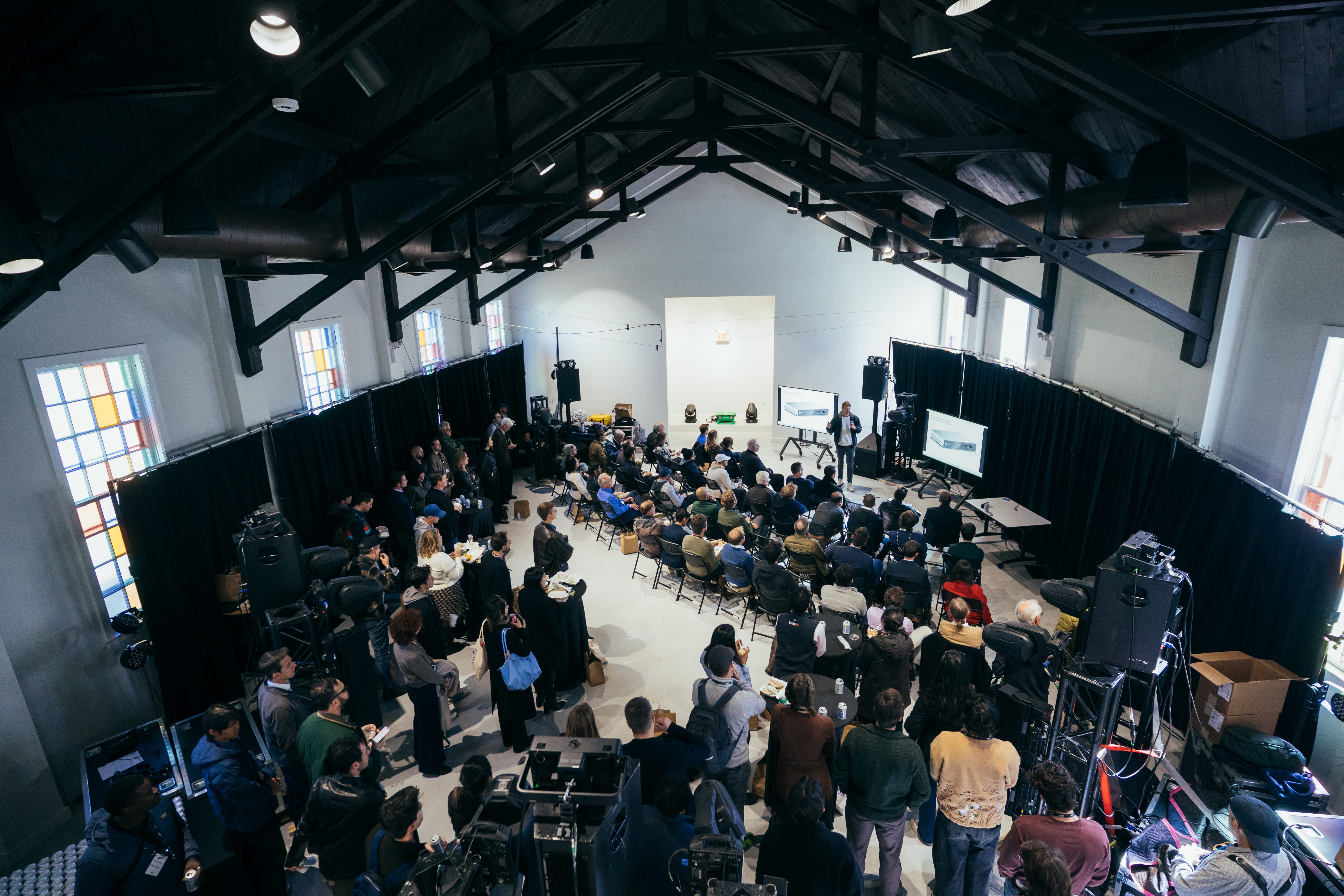
Throughout Thursday’s Leadership Summit, Friday’s four ThunDERdomes, one “Circuit Breaker” couch-side chat, six showcases, and five demos, and Saturday’s New Energy music festival, the DERTF community came together in its typically rollicking-to-riotous fashion to talk through this pivotal moment for the industry. And across all of the unfiltered hot takes and provocative debates, the discussions coalesced around several key themes.
Theme 1: Our time is now.
Perhaps the most unifying theme of DERVOS 2025 was the urgency of the moment – for the industry, for utility customers, and, without much exaggeration, for the future trajectory of the US economy and its international competitiveness.
Drivers of DERgency
First and foremost, spiraling electricity costs have become a pressing kitchen table concern, with utility bills increasing by 40% or more in some areas and 20% of Americans struggling to pay them. While these price increases are the result of multiple factors, the most immediately practical way to bring them down is the use of DERs like batteries, flexible demand, and aggregations of them in VPPs to shape load, reduce costly peaks on the grid, and maximize the utilization of our existing grid infrastructure.
Electricity affordability accordingly animated the first wargaming session of the Leadership Summit, with groups ideating intensely about ways to unlock the potential of DERs to deliver ratepayer relief. In the words of one prominent industry voice,2 “We’re in a moment where our services have never been more needed, and more important… people need us to be successful.” Put another way by Voltus’s Dana Guernsey the following afternoon at DERVOS, “We have real solutions for real problems – and not just wonky problems that a niche group of people understand.”
Rising electricity costs are also an existential risk to the competitiveness of US businesses, including for manufacturers and tech companies in vital “electrotech” sectors – like batteries, solar, drones, and robotics – that are key to national competitiveness in the 21st century. As Drew Baglino of Heron Power (and formerly Tesla) said during the day’s final panel “Energy Dominance and the Electrostate,” “no matter what we do with component costs for magnetics, power electronics, batteries – if the actual delivered cost of electricity goes up faster than the pace of inflation, all this is going to slow down.”
(And of course, no discussion of energy, urgency, and the future of the global economy would be complete without a deep dive into AI’s ravenous electricity needs – don’t worry, we’ll get there under Theme 2.)
The other primary driver is resilience. For many households, resilience against power outages has always been the fundamental value proposition driving DER adoption, as fear of losing power and desire for peace of mind motivate steadily-growing investments in backup generators and/or battery storage. An increasing number of businesses are more concretely adding up the impacts of grid outages on their bottom line and finding that microgrids with batteries and other DERs have a strong economic value proposition – as well as superior backup power performance compared to traditional diesel-fueled generators. And, as utilities increasingly learn to rely on VPPs as a grid resource, they’re finding that aggregations of DERs can be invaluable tools for ensuring gridwide reliability during spikes in demand.
While there was consensus that climate action per se is a less compelling driver for customers than it used to be, resilience as well as decarbonization were still ranked highly in the Community Survey as a motivating force for the industry itself. The increasingly-frequent extreme weather and associated outage risks that accompany climate change aren’t going away, either. As noted by Pila Energy co-founder and New Orleans native Cole Ashman, whose own journey has been motivated by his experiences losing power during Hurricane Katrina, there have been more billion-dollar disasters in the past 3 years than in the entire 2000s – and roughly 70% of US utility customers have experienced an outage long enough to spoil food in recent years.

VPPs Stepping Into the Moment
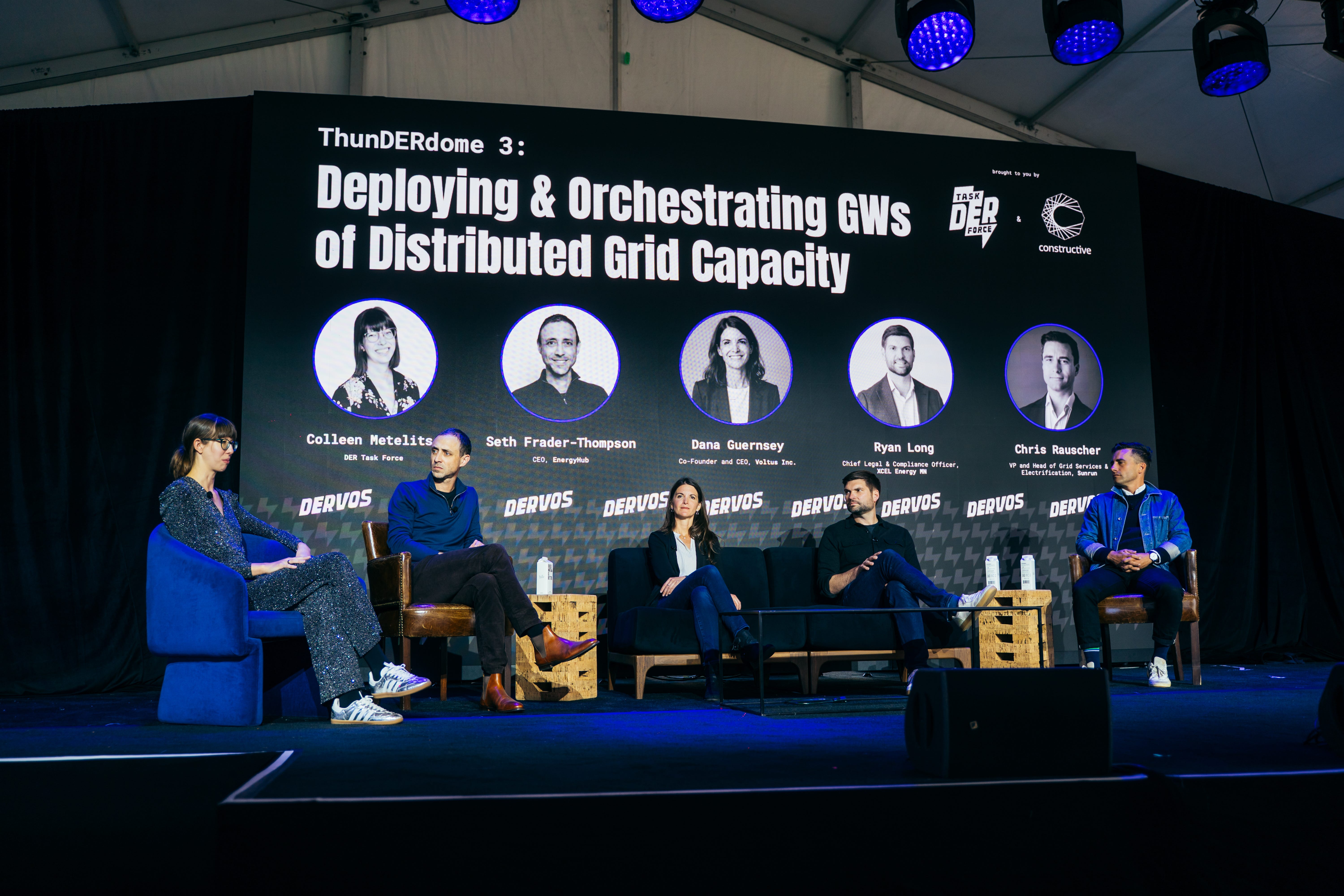
Metelitsa challenged the community to rise to the occasion in her opening remarks. “I don’t think there’s anybody outside this tent who’s going to figure it out for us – it’s actually you all. And it’s incumbent upon us to actually step into this moment and seize it.” And during the “Deploying & Orchestrating GWs of Distributed Capacity” panel that she moderated, several leading DER and VPP companies showed that they are already stepping in (and up) with appropriate alacrity.
Ever since DERVOS was DERTfest, there’s been a consensus that the core technologies of the DER stack – solar, battery storage, microgrid controls, and software to aggregate and orchestrate them – are ready to deploy and make an impact. But, more than in any previous year, DERVOS 2025 showcased stories of actual deployments at scales that show just how ready DERs are to help address today’s urgent cost and grid reliability challenges.
During the panel, speakers from several companies described how they are successfully “riding a wave” of mass adoption of solar, batteries, and EVs to achieve gigawatt-scale aggregations. EnergyHub President and co-founder Seth Frader-Thompson cited 2 million devices enrolled in its VPP platform, making it by some metrics the most populous in the US, and Voltus CEO and co-founder Dana Guernsey touted their 8 GW of DERs aggregated across North America, including flexible loads ranging in size from home thermostats to data centers.
Meanwhile, Chris Rauscher of leading solar installer Sunrun shared a pair of promising proof points from the 135,000 residential batteries it has enrolled in VPPs to date. Under California’s DSGS (Demand Side Grid Support) program – we’ll come back to that later – Sunrun and Tesla teamed up to dispatch over 500 MW of distributed power for two hours at a time last summer, cutting demand by 2% during the critical peak demand periods that disproportionately drive the state’s eye-watering electricity prices. And in Puerto Rico, Sunrun’s VPP has been dispatched dozens of times to help the utility avoid rolling blackouts – in fact, the Sunrun team received a notice to deploy that Friday night at DERVOS, so that “while we’re sitting here having cocktails, we’re going to help keep the lights on in Puerto Rico.”
Rauscher summed up the moment as well and as candidly as anyone, asserting that “scale, maturity, and need have all converged at the same time,” and that “if we had this need five years ago, I don’t think we would have been ready… So I think we are in the right place at the right time to really show our stuff.”
New Faces From New Places
In fact, this proven scale and maturity, and perhaps above all this urgent need for VPPs, are proving so compelling that they’re beginning to attract involvement from the industry’s historical antagonist: utilities. Faber-Thompson, Guernsey, and Raucher were joined on the panel by Ryan Long, an executive vice president at Xcel Energy, who discussed their recently-launched distributed capacity procurement (DCP) program. Under the DCP, called Capacity*Connect, the utility giant will own, operate, and aggregate battery storage assets at strategic, customer-sited locations on its distribution grid in Minnesota.
The rationale for the first-of-its-kind program, as Long explained, is that the utility’s understanding of the grid, and its ability to target specific circuits and feeders where batteries could solve problems, would allow it to “maximize the value of these resources across our system for our customers.” This idea of leveraging utility knowledge of the grid’s needs – and the utility’s ability to rate base investments – to help scale up the deployment of DERs was familiar to DERVOS regulars; Pier LaFarge of Sparkfund, who partnered with Xcel to launch the initiative, presented the DCP model on a panel at DERVOS two years ago.
The importance of locational pricing for maximizing DER and VPP value, and the challenges of working with most utilities under traditional market paradigms to realize that value, was a major topic that will be discussed in more detail under Theme 3. But the willingness of a major utility executive to brave the ThunDERdome was a striking feature of this year’s moment, and it will likely serve as a preview of future DERVOS discussions on the ever-evolving relationship between utilities and the DER industry.
Finally, in addition to highlighting new competition – or maybe coopetition? – from utilities, this year’s DERVOS moment was unique in the way that it foregrounded inspiration and motivation from examples overseas. Flavian Alexendru of Hypervolt, a UK company that was new to many attendees, impressed with a showcase featuring handsome home EV chargers with “world class, consumer-grade [design] that people love” and tales of managing a gigawatt of EV charging capacity across hundreds of thousands of customers, with expectations to add a gigawatt per year in the near future.
The most inescapable company of the event also hailed from the UK: Octopus Energy, whose iconic pink octopus mascot stuffies were omnipresent on Governors Island throughout the main event as well as the New Energy music festival. While their US retail operations are limited to the UK-like, fully-deregulated market of Texas, their Kraken software platform and flexibility-as-a-service offerings are beginning to gain traction with utilities in major American regulated markets, and CEO Nick Chaset’s couch-side chat with former Department of Energy Loan Programs head (and indefatigably acerbic industry voice) Jigar Shah was an eye-opening glimpse into the brave new world opening up for DERs in competitive markets.

“We operate the largest day-to-day virtual power plant in the world – it’s 3.5GW, with almost 400,000 electric vehicles that we optimize every single day,” Chaset boasted. “It’s not a call option that I’m going to call five times a year, it’s a core trading strategy of ours.” The value created by that charging optimization, which is powered by Kraken, enables Octopus to offer its UK customers 75% off the cost of charging – exactly the kind of win-win for ratepayers and the grid that this moment calls for in the US.
Urgently.
Theme 2: Our speed opens new frontiers.
Speaking of urgency, the third major driver of DER adoption in 2025 is… urgency, the literal need for speed(-to-power). Accordingly, a major focus of DERVOS was the expansion of DERs into new territories that weren’t even on the map three years ago, thanks to their ability to provide solutions to grid interconnection and speed-to-power challenges for end-users at scales ranging from small to XXL.
Permissionless Roots Revival
The second ThunDERdome panel of the day, “Permissionless DERs Wait for No One,” discussed an ostensibly new and “revolutionary” category of distributed energy – but it also harkened back to the very earliest days of the industry and the guerilla spirit of the group that DERTF took its name and inspiration from.
In 1973, the original Energy Task Force in New York City installed a repurposed 2 kW agricultural wind turbine on the roof of their Lower East Side co-op and used it to run their meter backwards for months… until ConEd noticed, and sued. The insurgents eventually won in court, and in the process laid the legal foundations for opening up monopoly utilities to competition via the Public Utilities Regulatory Policies Act (PURPA) of 1978.
Fast-forward to the DER Task Force, and DERVOS 2025, and we’re seeing the emergence of modern, more scalable versions of permissionless solutions, stoked by the urgency of rising electricity costs and resilience concerns as well as the frustrating slowness of today’s highly-”permissioned” paradigm for DERs – a paradigm that limits mass-market adoption with an installation and utility interconnection process fraught with delays, added soft costs, and uncertainty.
“You have to get permits, you talk to three different contractors, it’s a big upgrade project,” lamented Pila founder Ashman. “And most people don’t go through with it, even if they know they would benefit [from having DERs].”
Against this increasingly stagnant status quo, the panel’s ThunDERdomers once again looked across the Atlantic for inspiration. In Germany, skyrocketing electricity prices after Russia’s invasion of Ukraine in 2022 spurred adoption of “balcony solar” solutions that could simply plug into outlets and run meters backward, offering a DIY-installable consumer product with a quick payback.
To give a sense of the speed and scale that this model unlocks: thanks to generous subsidies dating back to the mid-2000s, Germany is one of the oldest and most mature rooftop solar markets in the world, with about 3.5 million installations over the past two decades… And in just 3 years, over 4 million balcony solar systems have been installed.
Unlike the truly permissionless guerilla tactics of the original Energy Task Force, this modern paradigm simply front-loads regulatory compliance, with designs that are certified by standards bodies (i.e. UL) for safe plugging-and-playing. In doing so, it transforms an electricity generation project, requiring an installation process carried out by certified electricians and permitted by utilities, into a consumer product like a microwave, which can be installed without specialized expertise or utility permitting – and, importantly, can be purchased by renters as well as homeowners, and moved within and between houses. In other words, it’s not just faster, it’s also more accessible, more flexible, and often cheaper, thanks to the elimination of so many of the soft costs that make the US one of the most expensive distributed solar markets in the world.
Could the permissionless paradigm pave the way to true mass-market DER adoption? The DERVOS panelists certainly think so, based on the off-the-cuff survey that moderator Campbell conducted. Compared to the slow-growing status quo, they envisioned a potential future of 50-90% DER adoption for homes and 70-80% for businesses (!). After all, in the not-unlikely scenario where most appliances have batteries integrated – a callback to last year’s DERVOS showcase of Impulse Labs’ battery-equipped induction stove – many people “might not even know” that they have a DER by default.
The New Post-Permission Paradigm
To more vividly demonstrate the truly ludicrous speed that this post-permission paradigm enables, DERVOS pitted permissionless battery startup Pila against Craftstrom, a permissionless solar and storage startup based in Houston with Austrian founders, in an “unboxing competition” that saw the time required to back up a refrigerator with battery power reduced from months to seconds (Craftstrom won, by a hair).
“Does anyone understand what the fuck just happened?,3” DERTF’s McGinniss asked incredulously. “Like, they literally just did a battery install in 17 seconds.” After the friendly competition, Pila’s Ashman and Craftstrom CEO Stephan Scherer had a chance to show off their respective plug-and-play solutions.
Pila’s battery caught eyes with its attractive, consumer-grade design, and nodded heads with a cellular mesh network that coordinates energy use across multiple devices and ensures continued monitoring and control during an outage. Then, Craftstrom distinguished itself with a complete modular power system including not only a battery but a lightweight balcony solar panel, which can be legally installed in all 50 states when paired with a smart inverter and power meter to prevent backfeeding into the grid (a limitation that non-profit Brightsaver is working to loosen, as we’ll discuss under Theme 4).
Both products were united by simple, intuitive plug-and-play architecture – plug the battery into a standard outlet, then plug in appliances and/or solar panels – and emphasized the simplicity of scaling up capacity by adding more units to grow with a customer’s energy cost savings and resilience needs. They also both offered smart controls that optimize charging to lower energy costs, automatically island devices during power outages… and, potentially, enable these devices to be aggregated into VPPs in the future.
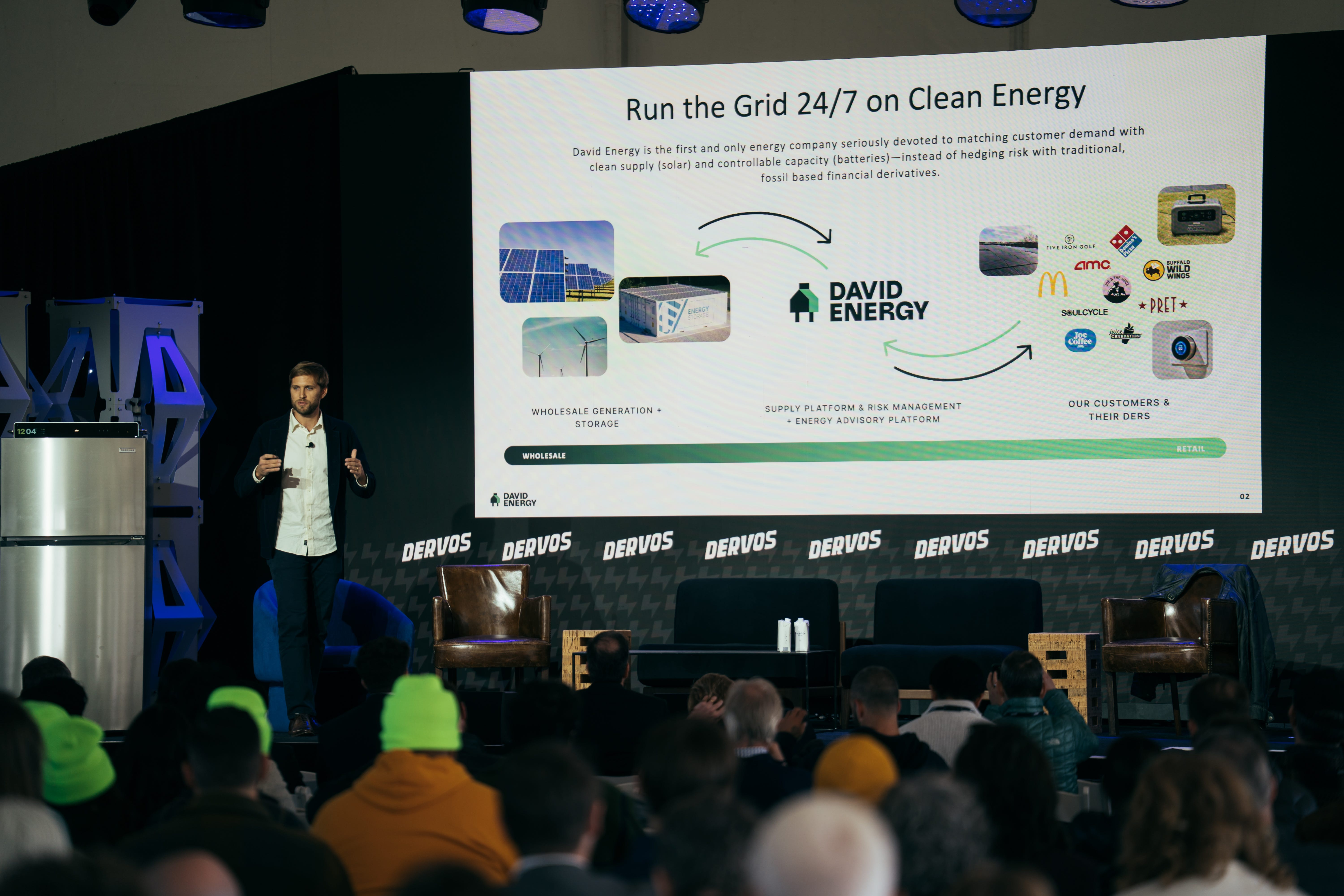
The permissionless revolution isn’t just for the residential space, either. Switching from DERTF emcee to David Energy founder mode, McGinniss discussed how his company has expanded its cost-saving retail offerings for commercial customers to include not only management of devices like smart thermostats but also the optimization of on-site, permissionless batteries from companies like Bluetti, whose portable batteries kept the DERTF faithful’s phones and laptops charged out on the Parade Ground lawn. While initially targeting customers with “spiky” loads like dryers, fryers, and mixers that can drive high demand charges, David Energy is also exploring the potential to aggregate permissionless batteries in VPPs as part of its broader strategy to minimize customer rates through granular clean energy hedging strategies.
Dwarfing these smaller plug-and-play devices, the permissionless panel also featured Bala Ramamurthy of Critical Loop (and formerly of SpaceX), who is targeting industrial customers with multi-MWh, fully-containerized battery systems that include integrated switchgear and controls. Like many traditional “bespoke” microgrid projects, Critical Loop aims to compete with “the most ubiquitous permissionless DER” – diesel backup generators – by pairing a more modern reliability solution with demand charge management that lowers energy costs, addressing both urgency drivers at once.
DCs, DERs, and… DC?
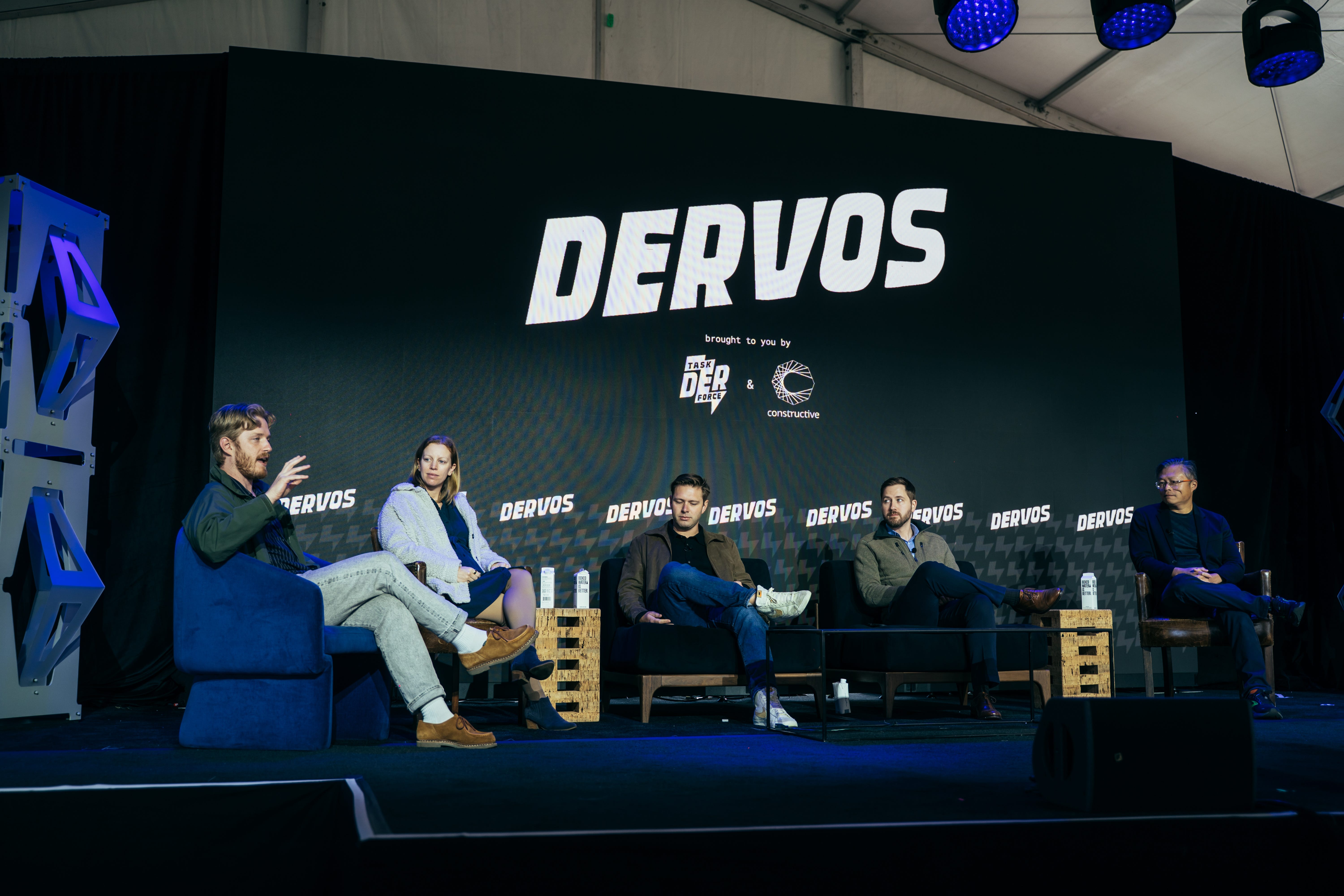
Perhaps the most paradigm-breaking and previously-unimaginable panel of the day was the cheekily-named “Big DERs Energy,” which brought together end-users (Hallie Carrao of Google’s Advanced Energy Labs), equipment suppliers (Tesla Megapack lead Sean Jones), developers (DC Grid founder Vic Shao), and academics (Duke University’s Tyler Norris)4 to talk through DER-centric solutions to arguably the moment’s most urgent – or, at least, biggest – energy challenge: powering the gigawatt-scale data centers required to power the suddenly-enormous AI economy.
Until recently, powering data centers was an afterthought: a large data center might need 100 MW of power, and their utility could usually get it to them in 9 months’ time. So if someone approached a data center operator three years ago and said they should explore DERs to power some or all of their site, “they would say ‘I would never do that, that’s crazy’,” in the words of panel moderator and DERTF co-founder Duncan Campbell – who, as the VP of Data Center Solutions at Scale Microgrids, has recently found himself developing these not-so-crazy-after-all projects.
That’s because, as utilities in a growing number of regions across the country get overwhelmed by both the gigawatt scale of today’s data centers and the sheer number of requests, data center developers are increasingly finding themselves facing wait times of 5 or more years for power… if they’re lucky. In the words of Duke’s Norris, “this is a case of an unstoppable force” – data center demand – “meeting an unmovable object” – the traditional model of power system planning, which requires building the grid to be able to meet all peak loads simultaneously and which is breaking down under the weight of today’s interconnection requests.
As a result, Google’s Carrao acknowledged that power supply has become the primary constraint on data center development, forcing the tech giant to adopt an ”energy-first mindset” when it comes to site selection. For Google, that also means “bringing new solutions to the table” that can scale quickly and make the entire power system more efficient through both technology and business model innovations.
In the context of the panel, these innovative solutions were summed up in a question posed by Campbell to frame the discussion: “Is there any way to scale the compute we need for the AI bull case in a manner that doesn’t include the majority of data centers either having DERs or being a DER?” – aka, embracing load flexibility to facilitate interconnection.
Spoiler alert: the answers ranged from “it’ll be very hard without that” to a succinct “no.”
To Be – Or To Have?
Load flexibility for data centers has been a popular topic ever since Norris’s seminal paper, “Rethinking Load Growth,” found that as much as 100 GW of new large loads (i.e. data centers) could be accommodated on today’s grid if they could cut their load for an average of 10 hours per year. This model builds on the precedent of ultra-large loads from previous eras – Campbell cited the historical analogy of aluminum smelters, which had their own “bespoke” arrangements with utilities that often required a certain amount of flexibility – and would also meet the expressed preference of Google (and other data center operators) for solutions that ultimately connect to the grid, for reasons of reliability, cost, and flexibility.
Still, establishing new service tiers for “non-firm” demand seeking flexible interconnections isn’t necessarily easy, and based on historical precedent could take years to go through various stakeholder reviews and regulatory processes. That said, the urgency of the moment might prod regulators to move more quickly; just a week after DERVOS,5 Department of Energy Secretary Chris Wright directed the Federal Energy Regulatory Commission (FERC) to propose new nationwide rules by the end of April 2026 to expedite interconnection of flexible large loads that agreed to be curtailable.
That said, Tesla’s Jones sounded a note of caution on the willingness of AI companies to curtail their data center loads for more than a handful of hours a year, given their “phenomenally expensive” equipment – $50 billion per GW for leading-edge NVIDIA chips – with only a 4-5 year lifetime. While Google has recently announced contracts that incorporate demand response and flexibility to improve speed-to-power, Carrao concurred with Jones, stating that she “[doesn’t] think flexibility will be a solution across all workloads,” and thus “can’t be something mandatory, and we can’t ramp down 100%.”
To get ahead of both regulatory uncertainty and curtailment concerns, a growing number of data center developers are planning to go beyond “being” a DER to actually “having” DERs that provide on-site power, including thermal (natural gas) generation, battery storage, and, potentially, massive solar arrays. Campbell, who helped spark conversation around multi-resource off-grid microgrids last year with his own white paper “Fast, scalable, clean, and cheap enough” (a collaboration with Stripe and Paces), described on-site power as something of a no regrets strategy, enabling companies to hedge their bets by moving ahead with projects while they wait for flexible interconnection opportunities – and then using on-site batteries to facilitate load flexibility without impacting their ultra-valuable operations.
Relatedly, the panel discussed the merits – or demerits – of DERs as “temporary” or “bridge” power solutions. DC Grid’s Vic Shao cited the example of his previous venture, Amply, which built on-site power solutions for EV charging stations: in many cases, their “temporary power” solutions, which customers only expected to need for 2-3 years, are still operating 5 years later, thanks to utility interconnection timelines that keep getting pushed back. Moreover, there’s often a strong economic case for having permanent on-site generation – Jones noted that batteries can often reduce energy costs by ~20% – so why not keep them around?
The ability of on-site batteries to “smooth out” data center loads may also offer essential technical capabilities for off-grid as well as grid-connected facilities. As noted by Jones, AI training data centers can see loads that vary up to 90% of their power demand at frequencies as fast as 10-30 Hertz – a ramp rate that would quickly damage natural gas generating equipment in the absence of a battery buffer. Even for grid-connected systems, Campbell asserted that “the utility is not happy about subcycle load fluctuations… It just feels like the end game is batteries everywhere.”
Powering data centers on-site also opens an intriguing new pathway for innovation: namely, the use of the direct current (DC) power produced by microgrid assets to directly power compute, instead of having to convert the AC power provided by the grid. As explained by the panel’s DC (and DC Grid) evangelist Shao, this eliminates conversion losses, minimizes waste heat and associated HVAC loads, and avoids the need for equipment like transformers that are in short supply. Another, even more radical solution was presented at Demo Day by Rune Energy – distributed data centers built on-site at solar and wind facilities to soak up excess DC power (that would otherwise be curtailed) and turn it into compute.
With all of the open questions about flexible interconnection policies, technology selection for on-site solutions, and the general complexity of operating data center microgrids with “these insanely volatile loads,” the panel seemed to end with more questions than answers – other than the consensus that, yes, Big DERs Energy will almost certainly play an important role in solving this moment’s biggest energy challenge. Given the speed at which DER developers like DC Grid and Scale Microgrids are moving towards implementing these solutions, it’s likely we’ll see some answers start to emerge in time for DERVOS 2026.
AI – Friend or Foundation?
AI unquestionably seems to be a major potential driver for DER growth, whether from “Big DER Energy” solutions that help meet data center electricity demand or from VPPs helping to manage the impacts of data center demand on the grid. But – can AI actually help DER companies more directly? The DERTF Community Survey revealed a lot of uncertainty, with over half of respondents landing somewhere between “not at all confident” and “not sure” on the question of whether AI and digital tools will improve DER economics over the next three years.

Across all the panels, showcases, and startups presenting on Demo Day, there was blessedly little of the vague “my company does _____ with AI” hand-waving that pervades the tech scene these days. But there were certainly shoutouts to the potential of AI to speed up existing workflows – for example, Tyler Norris estimated that he’s saved “thousands of hours” by using AI for research, and many, perhaps even most companies in the space who build software are using AI to speed up coding.
But two companies that presented were especially notable for their use of AI to create genuinely new, potentially game-changing tools for DER companies and the energy industry more broadly:
Halcyon: Halcyon.io is an AI-assisted platform that enables users to search millions of often-opaque and hard-to-access regulatory filings from FERC, ISOs, and PUCs nationwide and conduct natural-language queries, automating a process that can be prohibitively painful and time-consuming. The platform’s usefulness was demonstrated during the wargame scenarios at the Leadership Summit, where teams used Halcyon to, for instance, find examples of forcible curtailments of large loads, or of utilities that are ratebasing DERs.
Seeing groups create policy initiatives that drew on in-depth, comprehensive regulatory research compiled in minutes instead of months was an eye-opener, especially for the battle-scarred industry veterans assembled at the Leadership Summit, and it showed real promise as a tool for coordinating effective regulatory and policy actions for the industry in the future.
Paces: Paces.ai presented at DERVOS Demo Day with a very effective prop: a box full of tens of thousands of pages of the documentation that can accompany a typical energy project, as required for permitting, interconnection, environmental assessments and more. Paces has spent hundreds of human hours working through each phase of the project development process to build a single platform that uses AI to accelerate, automate, and parallelize the workflows represented by those paperful boxes, enabling developers to quickly eliminate non-viable sites and focus resources on projects with the best chance of moving forward.
By combining these AI tools with human-in-the-loop expertise, Paces estimates that the end-to-end development process can be sped up 10x, with specific steps sped up 1000x. And, as a true sign of the times, they’ve recently launched tools to assist siting decisions for large loads such as, to pick a completely random example… AI data centers.
Theme 3: Our economics are our destiny.
Delivering positive economic value for customers, and for the grid writ large, is the sine qua non of the industry’s success going forward. And another major theme of DERVOS, threaded through multiple panels and the Leadership Summit, was the not-entirely-tautological belief that this outcome can only be achieved through unleashing the true economic value of DERs.
Competitive Mechanics
In her discussion of the Community Survey results, DERTF’s Metelitsa emphasized that “the transition has to come at an affordable price… And we all know that can happen if we have the right mechanisms in place.” As the discussions on Governors Island and at the Leadership Summit made clear, that “right mechanism” is no longer the incentive programs the industry has leaned on in the past: it’s full-spectrum, unsubsidized participation in maximally, granularly competitive electricity markets.
And, as noted earlier, examples from the UK served as proof points for how DERs can succeed in these types of competitive markets, if given the chance – much as tales from Texas, the closest retail-competition market analogue in the US, animated panels on power markets as well as policy at DERVOS 2024. In this year’s edition, Karl Bach of the UK-based flexibility platform Axle Energy joined the Hypervolt showcase to outline how “the most advanced power market in the world” in the UK is turning 40 cents/kWh electricity prices into DER adoption at scale.
There, VPPs compete directly with large generators across the full range of market opportunities, drawing revenues from four main value streams:
Wholesale Markets: Buying low and selling high in day-ahead and intraday markets.
Peak Shaving: Managing grid peaks (“peak shaving”) via capacity markets or demand-side products.
Balancing: Fast-response services to maintain frequency and reserves.
Network Value: Distribution grid flexibility to alleviate congestion – and potentially defer or replace grid upgrades.
Meanwhile, in the US we’re similarly seeing $0.40+/kWh prices in states like California – but it’s not yet leading to the same pace of DER uptake, due in part to a lack of market access. That’s certainly a major diagnosis that emerged from the Leadership Summit, where simply “fixing market signals for DERs” was ranked as the most feasible and impactful near-term policy step for scaling up DER adoption. “If you have the right market signals, people will come.”
Currently, US market opportunities for DER participation are fragmented and limited, with most VPP revenue coming from demand response programs. While 2020’s much-hyped FERC Order 2222 led to much hope that DERs and VPPs would soon enjoy nationwide wholesale market access, including both energy and capacity markets, it was almost completely absent from discussions at DERVOS 2025 after repeated delays in ISO implementation plans.
Meanwhile, access to distribution grid value via locational pricing or other means remains hard to realize in most markets, although the Xcel distributed capacity procurement (DCP) pilot discussed under Theme 1 sets the important precedent of a utility recognizing that value. While hosting capacity maps can offer clues to where DERs might be most usefully deployed, the lack of opportunities to directly compete with distribution grid upgrades have prevented DERs from maximizing their potential value for alleviating location-specific challenges. As a result, as Voltus’s Guernsey memorably put it, “we’re all living in salad bar land, where the cucumber costs as much per pound as the caviar.”
And, while state-level incentives have helped to bridge the economics gap in some cases, California’s briefly-successful but recently-defunded DSGS program was cited (at length) as an example of how these types of programs are too limited by state budgets to truly scale, and too vulnerable to shifting political winds and whims to build a business around.
Winning Hearts and Markets
More broadly, the industry is still facing a fundamental hurdle: most utilities and ISOs don’t fully trust VPPs as a “real” resource that could help address increasingly-pressing cost and resilience challenges. To structure discussions around this issue, EnergyHub has coined a framework called the “Huels Test,” named after one of the VPP aggregator’s data scientists, which is analogous to the Turing test – but instead of defining when AI is indistinguishable from a human, the Huels Test defines when a VPP is indistinguishable from a traditional power plant.
At level 1, there’s basic demand response, with level 2 including active load shaping and locational dispatch; at level 3, the VPP passes the Huels Test, with full grid integration capabilities and the ability to automatically respond to market signals, and at level 4 it surpasses traditional power plants due to its ability to autonomously provide fully locational grid services on the distribution level. When asked, Frader-Thompson estimated that EnergyHub’s VPPs are currently somewhere between Level 2 and Level 3 – and, importantly, Xcel’s Long agreed, noting further that “I think once you get to Level 3, you’re going to have utility engineers and planners who are very happy to have those tools.”
Frader-Thompson acknowledged some “very unsexy” issues to resolve to get to true Level 3 performance – for example, breaking down silos within utility and market operator teams that historically haven’t had to work together – while also asserting that VPPs are very close on the technology side. Along these lines, much of the discussion at DERVOS, the Leadership Summit, and the responses to Community Survey highlighted the larger ongoing, non-technical question: how should the industry engage with utilities to open up access to these markets?
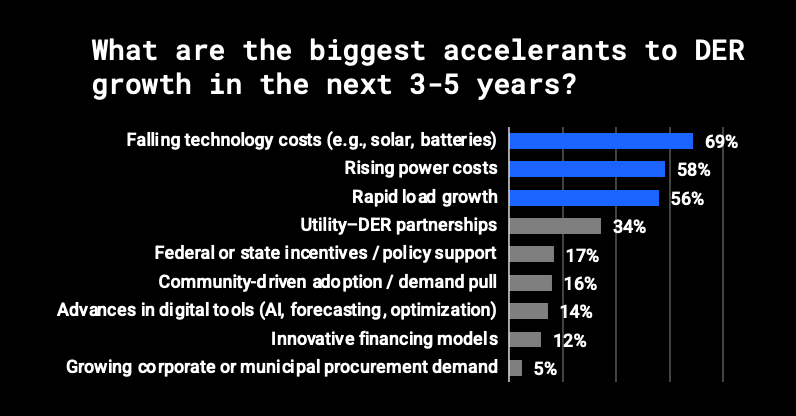
Xcel’s DCP program and Long’s participation in the ThunDERdome (not to mention the growing number of utility attendees at DERVOS) suggested an increasing recognition of the potential value of VPPs among utilities, as well as a greater willingness to engage with DER providers. The feeling is mutual – over a third of respondents to the Community Survey ranked “Utility-DER partnerships” as one of the biggest potential near-term accelerants to DER growth.
For those hopeful for closer collaboration, Long’s closing statement of belief in the power of utility-DER dialogue was a heartwarming highlight of the day that deserves quoting at length: “I think we need to talk to each other more, and I think that there is a whole lot of collaboration and success that we can have together. I would love to do a job swap with one of you, just to live in your shoes and have to deal with the utility… I think more of that empathy building is really valuable for our collective industries.”
As sweet and sincerely DERTFian as that sentiment was, other, more realpolitik-tinged DERVOS discussions centered around the importance of building leverage in the ongoing utility-DER relationship through sheer scale of DERployment. The growing critical mass of DERs on the distribution grid is already creating enormous and largely-untapped opportunities to ease pressure on costs and deliver value for customers, and the potential for radical acceleration of this growth via permissionless DERs – and EVs, which are projected to surpass the capacity of stationary storage resources by 2030 – could ultimately force utilities to change the way they operate their systems.
Of course the most powerful, most immediate, and not at all mutually-exclusive form of leverage could come from regulators, legislatures, and/or governors – who could require utilities to consider the value of DERs and VPPs, instead of defaulting to the slower and often more-expensive solution of rate-basing distribution grid upgrades. Which brings us to the next big Theme…
Theme 4: Our politics are local.
Uncertainty over federal policies on tax credits and tariffs was understandably ranked as the #1 risk to DER growth in the Community Survey, and DERVOS closed with a ThunDERdome full of heady questions about whether and how the US industrial economy could compete with China on “electrotech” given the petrostate predilections of the current administration.
But at the same time, and as in previous years, the majority of policy-related discussions at DERVOS and the Leadership Summit swirled around state-level issues. Even before the radical federal whipsawing of the past year, the DERTF community has always had a non-partisan flavor and a state policy focus appropriate for the localized nature of distributed energy; after all, as EnergyHub’s Frader-Thompson put it, “my company, like a lot of companies here, has always been way more driven by the states [than federal policy].”

Helping Electeds Help Their Constituents
Electricity affordability is squarely on the radar of elected officials, with skyrocketing rates leading electricity to become “the number one issue” in November’s governors races in Virginia and New Jersey,6 according to one speaker at the Leadership Summit. Incumbent Pennsylvania Governor Josh Shapiro and outgoing Virginia Governor Glenn Youngkin have also threatened to leave the PJM market, prompting the Leadership Summit speaker to quip that “the governors have spoken – I don’t think they know what they’re doing, but they actually want change right now.”
DERs and VPPs offer the fastest path to the change desired by elected officials and their constituents – so, what kinds of policy changes should these governors (and legislators) make to win on this issue? Several areas for action came up repeatedly across DERVOS and the Leadership Summit:
Require Utilities to Utilize: To minimize cost increases from building new grid infrastructure, regulators should require utilities to maximize the utilization of existing grid infrastructure that has already been paid for. This would effectively force utilities to allow VPPs and other non-wires alternatives (NWAs) to compete with traditional distribution grid upgrades, guiding DER deployment and dispatch to provide the greatest locational value for the grid and its end-users.
Flexible Interconnection: Flexible interconnection policies would create a path for large loads (i.e. data centers) to connect to the grid sooner by agreeing to curtail their electricity use during periods of peak demand – potentially by drawing on on-site batteries or other DERs. A related “Bring Your Own Capacity” (aka BYOC) concept was discussed during the Leadership Summit, which would actively require data centers to secure capacity from DERs or VPPs for this purpose. Another twist on this idea from the Leadership Summit proposed charging data centers expedited permitting fees, which would then be used to deploy DERs and VPPs on the rest of the grid.
Permissionless Backfeeding: To scale permissionless DERs at the pace we’re seeing in Germany, states will need to follow its lead in adopting a key enabling policy. In Germany, balcony solar and battery systems are allowed to export a limited amount of excess energy to the grid, which facilitates larger systems with more value for customers – according to Craftstrom’s Scherer, in Germany balcony solar is “the best investment you can make,” with a payback in less than 2 years. Brightsaver, a US non-profit whose co-founder and Executive Director Kevin Chou joined the permissionless panel, has passed legislation in Utah that exempts systems up to 1.2 kW in size from permitting and allows them to backfeed into the grid – and they’re working on similar proposals in more than a dozen states and counting.
Valuing Resilience: While resilience has incredibly tangible value for homes and businesses during a grid outage, it’s also a part of the DER value stack that is too often ignored by utilities and regulators in evaluations of project economics. A variety of policy solutions to plug this gap were discussed during the Leadership Summit’s resilience-focused scenarios, including one proposal that would allow utilities to rate base microgrids sited at essential facilities, and another that would subsidize batteries in high-risk areas in exchange for the ability to use them to support the grid during emergencies.
This is How We Win
The DERTF community has never lacked for policy ideas – but having the right solutions on our side isn’t enough to remove foundational barriers to DER deployment. In the blunt words of one Leadership Summit attendee, “this industry doesn’t have power,” and a significant chunk of the Summit was spent discussing what the industry has to do to fix that problem.
One of the advantages of a focus on state-level policymaking is that well-targeted financial support and issue advocacy can go farther than it can amidst the expensive, hyper-polarized cacophony of national politics. “A lot of the real power that this industry needs is going to be in boring places and boring elections like state legislatures and governors races,” as one speaker put it. And donations to the right candidates aren’t just about helping them win races – it provides opportunities to educate them about our industry’s wonky-sounding but urgently-needed solutions.
For example, the recently-formed advocacy group Deploy Action supports DERTF-friendly policies like enabling frameworks for VPPs, and it has focused initial efforts on California. One candidate it has championed is State Senator Josh Becker, who proposed successful legislation to require more rigorous scrutiny of utility spending, as well as an accompanying bill aiming to facilitate more demand-side flexibility that passed before ultimately being vetoed by Governor Gavin Newsom.
To build on this model, the industry needs to find “a thousand Josh Beckers” in state-level races across the country. “We need to back the right people early – before they’re in charge,” one Leadership Summit attendee asserted. Deploy Action is working to expand its activities to 8 other states, including New York and Texas, and the 2026 elections are (already) right around the corner.
So, to return to a common thread throughout the proceedings: the time is also now for the industry to get serious about building political power.
The VPP Convergence Project
The Leadership Summit served as something of an unofficial launch party for the VPP Convergence Project, a new policy initiative announced earlier that week by the Energy Policy Design Institute. With Jigar Shah as honorary chair and long-time DERTF collaborator (and now Sparkfund VP of Regulatory Affairs) Allison Bates Wannop on the steering committee, and companies like EnergyHub, Sunrun, Tesla, and Voltus as industry advisors, the Project’s members as well as its message have deep roots in the DERTF community.
But, while we are well aware of the value of VPPs and the policies that they require to succeed, the state PUCs and policymakers responsible for proposing and implementing them typically “aren’t well educated” on them, as one Community Survey respondent noted. That’s understandable – VPP programs are relatively new, and inevitably complex to put in place. That said, during the VPP panel Voltus’s Guernsey noted that “fragmentation of programs is fine,” and likely necessary given differences between state and regional markets, “but best practices on program components need to be aligned around the country.”
To this end, the Project aims to catalyze a “convergence of policy ideas and resources” that will enable VPPs to address today’s convergence of pressing grid challenges. Instead of advocating for any particular program design, the Project’s work will focus on empowering policymakers and PUCs with the information, evidence, best practices, and tools they need to understand and implement VPP solutions that meet their specific needs.
Part of the Project’s mission is also to share insights across the industry, and to “empower stakeholders to speak credibly and effectively.” Stay tuned – this will undoubtedly (still) be a major topic of interest for DERVOS 2026.
Theme 5: Our community is dope.
As everyone who’s ever attended a DERVOS knows, or as anyone who has read this far can hopefully see, DERVOS isn’t your typical industry conference – which reflects the fact that DERTF isn’t your typical “industry group.” This community has grown organically, from live meetups in NYC to a podcast to virtual meetups during Covid to a 3,500+ member Slack channel to regular meetups in multiple cities to DERTF to DERVOS – all of which “makes this feel like family and fun and friends,” as DERTF’s Metelitsa put it.
It’s also a community that prizes authenticity and real talk – no matter how spicy the takes or raw the language, as “Quotes from the ThunDERdome” below makes clear. As one attendee said during happy hour, “at a finance conference people say what they’re supposed to say for their company… This feels a lot more unfiltered – people actually just say what they think.”
At the same time, DERVOS isn’t just for sharing fresh takes with fun friends. “Bringing this community together to figure out how we can grow together” has always been the goal of DERTF, and it’s the animating force behind these events. So, in addition to coming together to build political power, as discussed in the previous section, how can the power of this community be harnessed going forward?
Enabling Interoperability and Alignment
Just as the DERTF community brings together a convergence of stakeholders throughout the DER ecosystem, the effective leveraging of DERs and VPPs requires coordination across different technologies, as well as between system operators and aggregators. Accordingly, “standardization & interoperability across technologies” was identified as one of the biggest potential accelerants to DER growth over the next 5-10 years in the Community Survey, behind only the previously-discussed topics of scaling up DERployment itself and the maturation of regulatory frameworks.
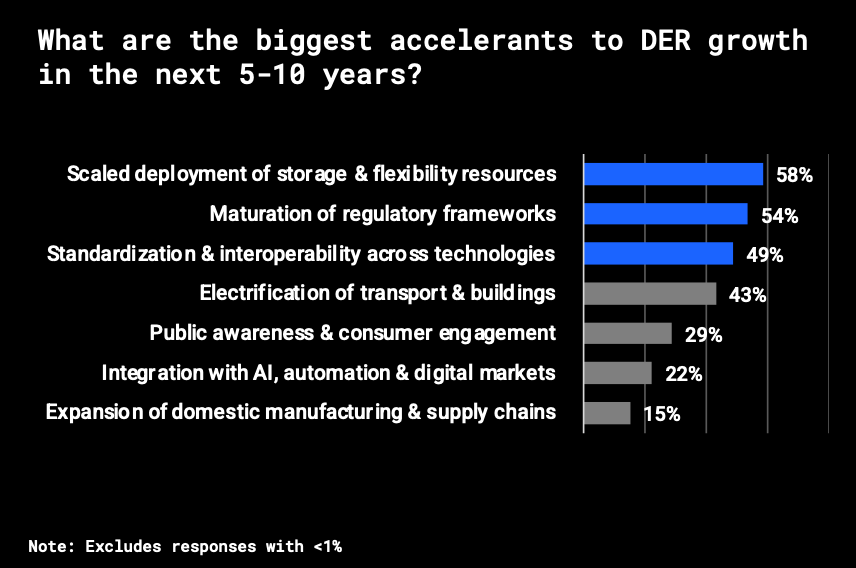
This theme was elaborated further in the Community Survey comments. For example, in response to a question about what gaps need to be addressed by industry groups, one DERTFer highlighted “interoperability and standardization to enable smarter, faster networks of DERs to be deployed at scale to meet grid demand.” Others echoed the point while emphasizing the virtues of an open-source solution, including one respondent who called for “free and open standard application-layer protocols like http/smtp that all DERMS have to support.”
One effort in this direction discussed at DERVOS was Octopus’s Mercury Consortium. This non-profit collaboration spearheaded by Kraken (Octopus’s aforementioned software tentacle) and the US-based Electric Power Research Institute (EPRI) aims to create a “Bluetooth-like” interoperability framework to simplify the connection of DERs to DERMS and VPP software platforms. Another DERVOS exhibitor, Elastic Energy,7 is working to address this challenge with a full-stack, software-plus-hardware “energy router” that adapts to evolving DER standards, so equipment from different vendors can keep working together with each other and the grid without custom integrations.
Relatedly, improving access to utility data is a perennial issue for the DERTF community, and it was unsurprisingly brought up during the VPP panel as well as in Community Survey comments – one respondent urged DERTF to apply “more pressure to get us easy access to customer meter data.” At Demo Day, startup Bayou Energy presented one path forward, with an API aiming to be a “Plaid for utility data” that makes it easier to connect DER software solutions with customer utility accounts. Given the growing need for interoperability across the utility-DER ecosystem as the industry scales up, and as utility partnerships (potentially) deepen, these topics in all their permutations could be a growing focus for future DERVOSes.
Aligning the industry’s messaging is important too. One survey respondent identified “fragmentation, lack of coalitions, and no common language” as the industry’s “biggest issue.” While it’s probably inevitable that such a diverse, independent-minded, and often-unruly group as DERTF would have a hard time aligning around a shared vocabulary, DERVOS is exactly the kind of IRL discursive engine that can generate it.
As Impulse’s D’Amico said at happy hour, “it feels like there’s a narrative convergence happening – and this is the scene where it’s starting to happen, and where we can kind of get everyone speaking the same language.” Indeed, the “Energy Dominance and the Electrostate” panel that D’Amico joined just prior to the happy hour was emblematic of this storytelling synchronization, with “electrotech” emerging as a post-partisan, technology-forward alternative to “climatetech” in recent months – a timely repositioning spearheaded by the think tank Ember, whose Daan Watler also appeared on the panel and whose widely-cited paper “The Electrotech Revolution” is often credited with popularizing the term.
Of course, given the pace of change in the industry, the world, and the communication-sphere, who knows how the DER lingua franca will evolve over the next year? All we know is that DERVOS will (probably) be the place to find out.
DERTF Vibes Only
Beyond all the inspiration, ideation, occasional consternation, and above all motivation shared on stage throughout DERVOS, a lot of what this event “meant” was about the community itself. Bringing everyone together in one (spectacular) location really crystallized and amplified the ultra-distinctive DERTF terroir – you could say ‘vibe’ – that has remained a constant even while the event draws bigger crowds, bigger names, and bigger DER energy every year.
It started at the Leadership Summit at Newlab, with its raucous “wargaming” amongst industry veterans unafraid to learn from each other, have some fun, and even be a little vulnerable as they stepped into each other’s metaphorical shoes and role-played through various scenarios. Tables toggled between earnest policy arguments and making occasionally-outlandish proposals – one Texas scenario group came up with a “Generation Reliability Innovation Financial Trust” program, aka GRIFT, and the California table was heard discussing DERs for cloud seeding to reduce wildfire risk. “Can we make California wetter?”
The mix of seriousness and spiciness at the Leadership Summit was classic DERTF, and it also felt like a full-circle moment. The original DERTFest was held in the same room, with a scrappy group of less than 200 attendees thrown into a series of similar small-group exercises in between panels – an atmosphere that really brought the community together in a new, very un-conference way. The fact that DERTF can now assemble a distinguished group of industry leaders and create that same type of dynamic was striking on multiple levels, and it will be fascinating to see what kinds of new connections and collaborations emerge from it.
Then, on the day of the main event on Governors Island, all the energy inside the tent was perfectly complemented and supplemented by the sun-powered vibes outside. Being literally in “island mode” reinforced the feeling of close-knit community, as the Parade Ground setting created an illusion of isolation from the city that was pierced only by the skyline in the distance and the (frequent) whirring of helicopters whizzing across the harbor. This community has always been marked by a sense of openness, and seeing attendees making new friends over burritos on the lawn during lunch, holding impromptu meetings at picnic tables in the afternoon, and having passionately wonky conversations over pizza and drinks long after dark8 all felt like quintessentially DERTFian scenes.
This spirit carried over into Saturday’s solar and storage-powered concert, the aptly named New Energy music festival. In the words of the festival’s driving force, DERTF/David Energy’s McGinniss – who spearheaded a smaller-scale concert in the Newlab parking lot after DERVOS 2024 – “if we really want to make change, we need to get the broader public on board” with the potential and promise of distributed energy. This evangelistic goal was reflected in a broadly-curated, DER-fueled lineup for the festival that included local rock (Gift), electronic (Doss), rap (Junglepussy), and dance acts (Ivan Berko), as well as the unclassifiable highlight that was experimental/pop/electronic act Eartheater’s first NYC performance in over a year.
Surrounded by eclectic, diverse, and intensely passionate fans trekking to the unusual location to see her, Eartheater shouted out the festival for “doing something new and innovative and hard ” – which is something she knows about, as an artist who came up through Brooklyn’s experimental DIY music community to become a sui generis crossover success. In a sense, this connection between pioneers in energy and music felt like something of a 21st century callback to the spirit of the original Energy Task Force, which emerged from the same anti-authoritarian DIY ferment in New York’s Lower East Side as the legendary arts scenes around the Nuyorican Poets Cafe, loft jazz venues like Studio We, and punk squat ABC No Rio.
As we took the late night hybrid-electric ferry back to the mainland along with a mix of overstimulated energy geeks and Eartheater diehards clutching bright pink Octopus Energy stuffies, it felt like a fitting way to close out the three days and nights of DERVOS – as well as the start of a new, bigger, and more urgent chapter for the DERTF community.
We’re looking forward to next year already.

Overheard in the ThunDERdome
“Honestly, the grid feels a little fucked up right now.”
“The haters have no idea what they’re talking about.”
“The electricity bills are too damned high!”
“Most conferences I can just bullshit because no one knows anything. Well, you guys know stuff, and so I’m like, very nervous.”
“I feel like there’s just so much money that should be falling on me right now.”
“There’s nothing fucking virtual about them at all – seriously, they’re distributed fucking power plants.”
“Make the diversified conglomerate sexy again!”
“Will we be an electrostate in 50 years? Yes – and the tanks will be woke.”
BIIIGGGG Shouts
The team at DER Task Force would like to acknowledge and thank all those who made DERVOS what it was this year!
To start, we couldn’t have done this event at all without our sponsors.
OFF GRID
Octopus Energy
Scale Microgrids
MICRO GRID
Amazon
Arcadia
David Energy
Goldman Sachs
Goodleap
Hypervolt
Solarpunks
Sparkfund
Sunrun
GRID TIED
ConEd
Craftstrom
Energy Hub
Enode
Halcyon
Leap
NineDot
Ohm Analytics
Paces
Voltus
With appreciation to our speakers, presenters and performers across the three days:
LEADERSHIP DAY
Seth Frader-Thompson, CEO, Energy Hub
Susan Kish, CEO & Co-Founder, Constructive
Alex Klaessig, Chief Data Officer & Co-Founder, Halcyon
Colleen Metelitsa, Sr. Director of Strategy, Scale Microgrids
Jigar Shah, Co-Managing Partner, Multiplier
Daan Walter, Principal, Ember
Jonah Wagner, President & Co-Founder, Constructive
MAIN DAY
Flavian Alexandru, Founder & CEO, Hypervolt
Cole Ashman, Founder & CEO, Pila
Karl Bach, Co-Founder & CEO, Axle Energy
Drew Baglino, CEO, Heron Power
Duncan Campbell, VP Data Center Solutions, Scale Microgrids
Hallie Carrao, Technical Program Manager, Energy, Google
Nick Chaset, CEO, Octopus Energy US
Kevin Chou, Executive Director & Founder, Bright Saver
Sam D’Amico, CEO, Impulse Labs
Tristan Doherty, Chief Product Officer, LG
Seth Frader-Thompson, CEO, Energy Hub
James Gordey, Co-Founder & CEO, Bayou
Dana Guernsey, CEO & Co-Founder, Voltus
Susan Kish, CEO & Co-Founder, Constructive
William Layden, Co-Founder & CEO, Rune
Ryan Long, Chief Legal & Compliance Officer, XCEL Energy
Joti Mangat, CRO, Hypervolt
James McGinniss, CEO & Co-Founder, David Energy
James McWalters, CEO, Paces
Colleen Metelitsa, Sr. Director of Strategy, Scale Microgrids
Tyler Norris, James B. Duke Fellow, Duke University
Jesse Peltan, Founder, Type 1
Chris Rauscher, VP & Head of Grid Services & Electrification, Sunrun
Bala Ramamurthy, CEO, Critical Loop, Inc.
Stephan Scherer, Founder & CEO, CraftStrom
Jigar Shah, Co-Managing Partner, Multiplier
Sean Jones, Lead, Market Development - Data Centers, Tesla
Vic Shao, Founder and CEO, DC Grid
Sam Tegel, CEO, Electron X
Daan Walter, Principal, Ember
Jonah Wagner, President & Co-Founder, Constructive
NEW ENERGY PERFORMERS
Eartheater
Junglepussy
Doss
Gift
DJ Ivan Berko
With appreciation to our strategic partners: Constructive (Susan Kish, Jonah Wagner, Liz Manero, Alix Mills, Rosie Jewell & Jason Ramos), Jigar Shah, Tim Hade and The Trust of Governors Island.
To AdHoc and Ray Bloch who worked around the clock to build and produce this event.
The core DER Task Force leadership team who dedicates hours/days/years of volunteer time to make this community and event function: Duncan Campbell, James McGinniss, Colleen Metelitsa, Nicole Green, and Allison Wannop.
And finally, a massive shoutout to John Atkinson, the author of this novella-length chronicle. As you can tell, John is a serious DER nerd and writerly type who has been a DER Task Force member and DERTFest/DERVOS participant since the very start. We are endlessly grateful for his painstaking work to tell our story in our voice.
To all the DER Task Force community, the DERVOS participants, and the wonderful volunteers at DERVOS 2025 - we thank you and hope to see you next year!
This paper was brought to us by one of our main sponsors:

“Distributed Energy Resources,” an increasingly-expansive, imprecisely-defined, and debatably pronounced (“D-E-Rs” more widely used, “Durs” more fun to say) category of energy resources sited with customers, e.g. rooftop solar panels on a home or a manufacturing facility microgrid with a battery.
As the Leadership Summit was conducted under Chatham House rule, attendees will not be identified and quotes will not be attributed.
My neighbor in the audience, a DER-curious architect, clearly understood – she leaned over in only half-mock awe, whispering “I think I’m getting DER-pilled…”
After hinting at an imminent career move at DERVOS, Norris joined Google’s Advanced Energy team in mid-November.
A coincidence?
Both of which were ultimately won by Democrats.
Whose heavy metal-inspired t-shirts rivaled Octopus’s pink stuffies and (of course) DERTF’s black “Microgrids are Dope” sweatshirts as the coolest merch in the tent.
Note for next year: bring solar-powered lanterns, this group hangs LATE.
